Stock Ideas
Pan India market leader in women’s ethnic wear category, Mx – highest in its category, but low overall given a 20-30% share occupied by organised players.
Why we like it, and our thoughts on certain key points.
Strong organic growth underappreciated
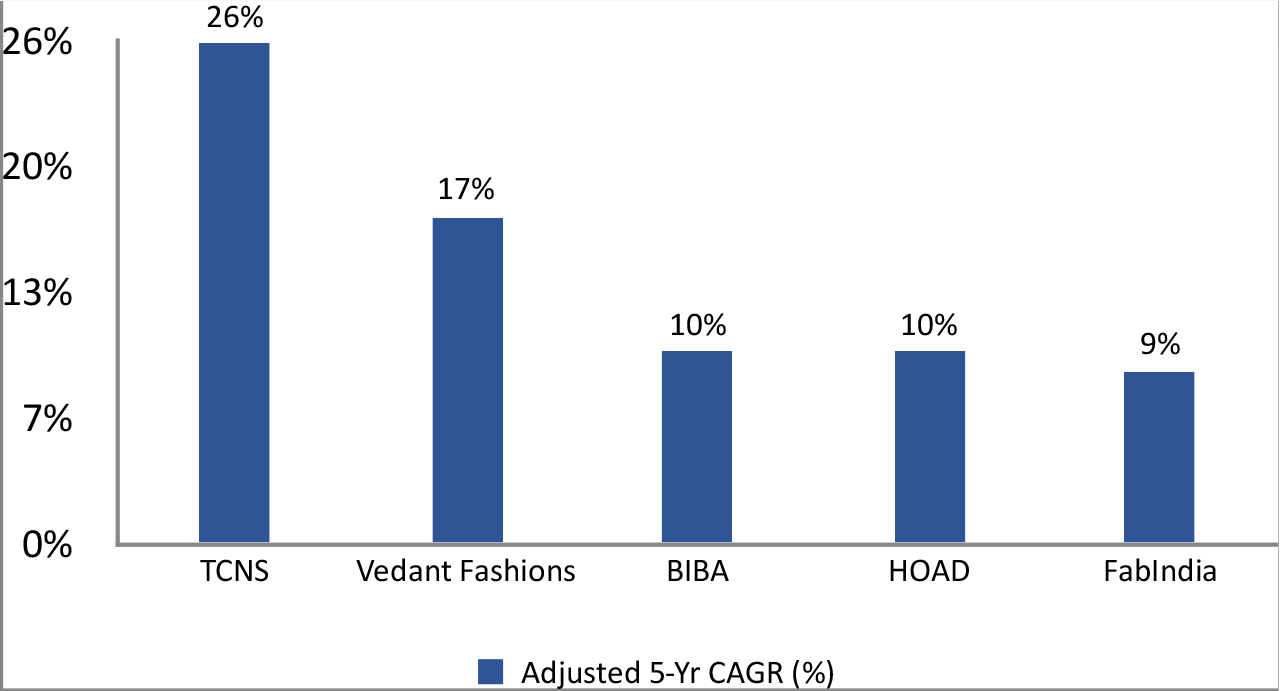
Heavy ramp up in store count, focus on being product centric vs channel centric, multi-channel approach, has led to an impressive ~37% sales cagr for FY13-FY20. It’s difficult to grow so fast without fumbling, testament to their execution skills. Retail comes down to execution, which in turn depends on gePng the supply chain right backed by a good product fit. Discretionary spends in general have been under pressure in India for the past 3-4 years, and we think once the up cycle is strongly underway, the potential remains to surprise on the upside on sales growth. The company admittedly has an extensive ESOP policy (~10-11% dilution over next 3 years), but growth has not come on the back of increasing debt. Balance sheet has remained debt light.

Balance Sheet strength, Gross margin vs Lower payable days, approach towards expansion
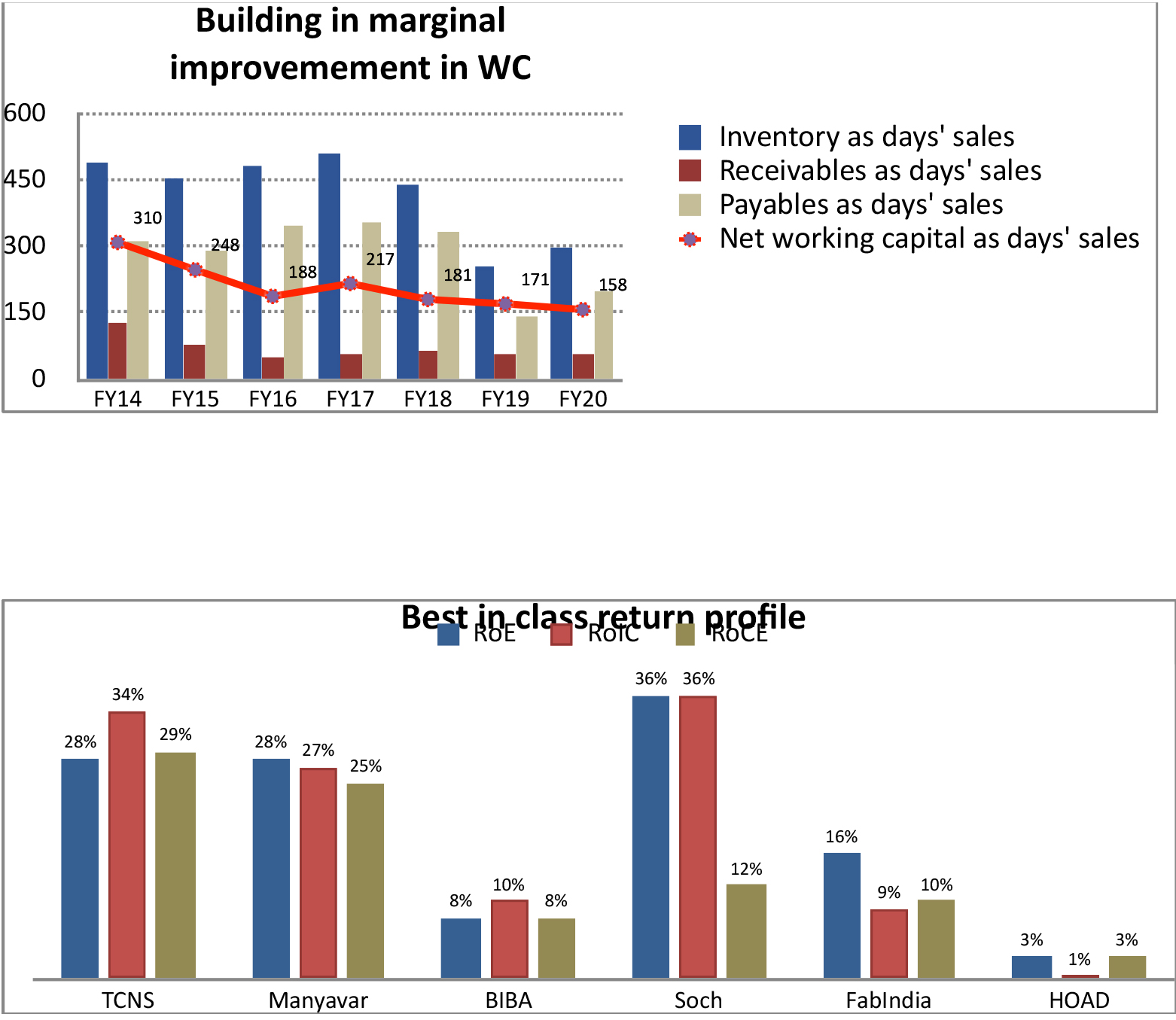
Manufacturing is 100% outsourced, while design is 100% in-house. 40% of its stores are run by franchisees. Building an agile supply chain in ethnic wear is relatively tough, given a high number of fabrics+trim materials to sort through, to ensure a good product fit year ader year. Navigating the seasonality in the business i.e fashion trends, separates the winners from the losers over Hme. We feel the company has embarked on a correct strategy of paying its vendors before time, supporting them, shiding vendors to low cost areas away from Delhi-Ncr. While this may elevate the Working Capital due to lower payable days, the bigger priority is to ensure a smoothly running efficient supply chain. That is key!
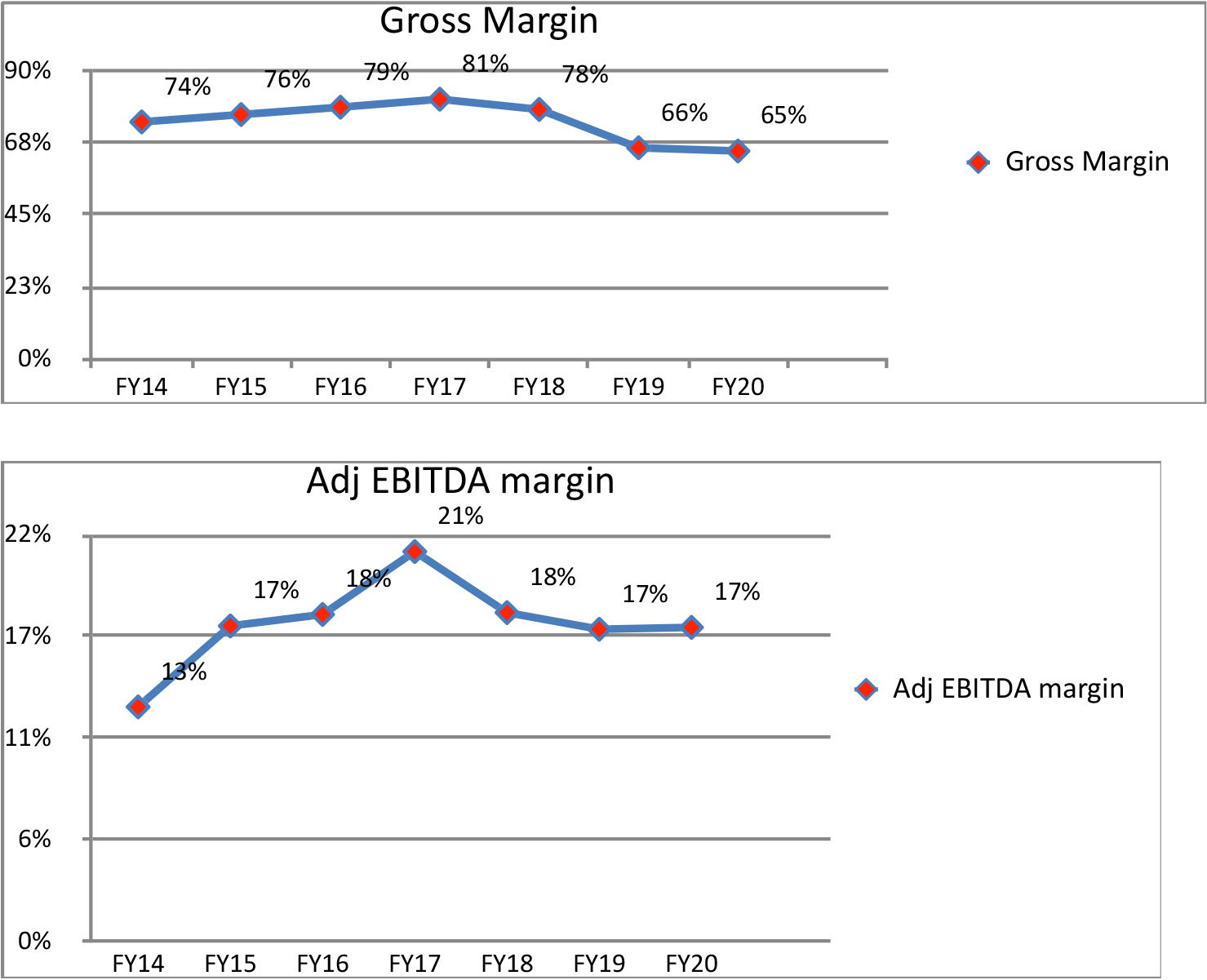
Instead, the company has focused on lower discounting & ensuring GM% is high. While larger fashion companies operate on gross margins of 50-55%, Tcns is at 62-63% gross margin.
The combination of minimal capex, higher GM%, franchisee share %, lower payable days has resulted in higher ROIC% vs peers.
“we are not in a standard product business where we sell the same thing season ader season = in our business at times depending upon fabric, fashion, depending upon whether you are selling one piece dress or you are selling three different pieces, your ASPs and volumes both can go in any direction, but this is something which is fashion. A person might buy three different pieces to make a combination or another person might get one dress and that is how consumers behave.”
“we have taken a route of slightly protecting our gross margins.”
“our focus is to get products on time, we think the gain from selling it full price would be much more than whatever inventory carrying cost that we have.”
“we have repeatedly said that we are trying to set up a low-cost base and we are also using cash on our balance sheet to get better rates for our products and that gain is reflected in gross margin. We are deliberately paying creditors before time, this is something that we actually can reverse any time”
“We have been paying our suppliers ahead of time which can be reviewed as per current situation. However, we will continue to be equitable partners and will continue to support our vendors.”
“we have been able to negotiate better in terms of fabric cost by giving better credit terms.”
“if you look at our working capital days generally it is about 100 days to 120 days and this is what we have been able to maintain over seasons, so last year, this year all these are in the similar range.”
“So, as a company we are focused on gross margins because we believe that in the long term that is what protects the brand integrity. Also, rather than just gaining revenue share in the short term by selling stuff on discount, which is not anyway great for margins, it’s better to control inventory and try to increase your full price sales. So lot of the efforts that the company is taking is on these lines, we have a rethink on the way we are creating the merchandise mix we are rethinking the way we are thinking of supply chain. So, for example today lots of our products are getting delivered in 60 days/in less than 60 days, which was not the case earlier.”
Valuations
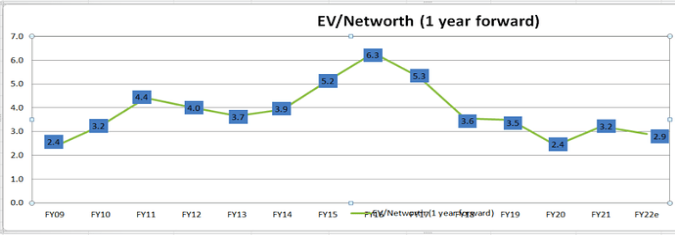
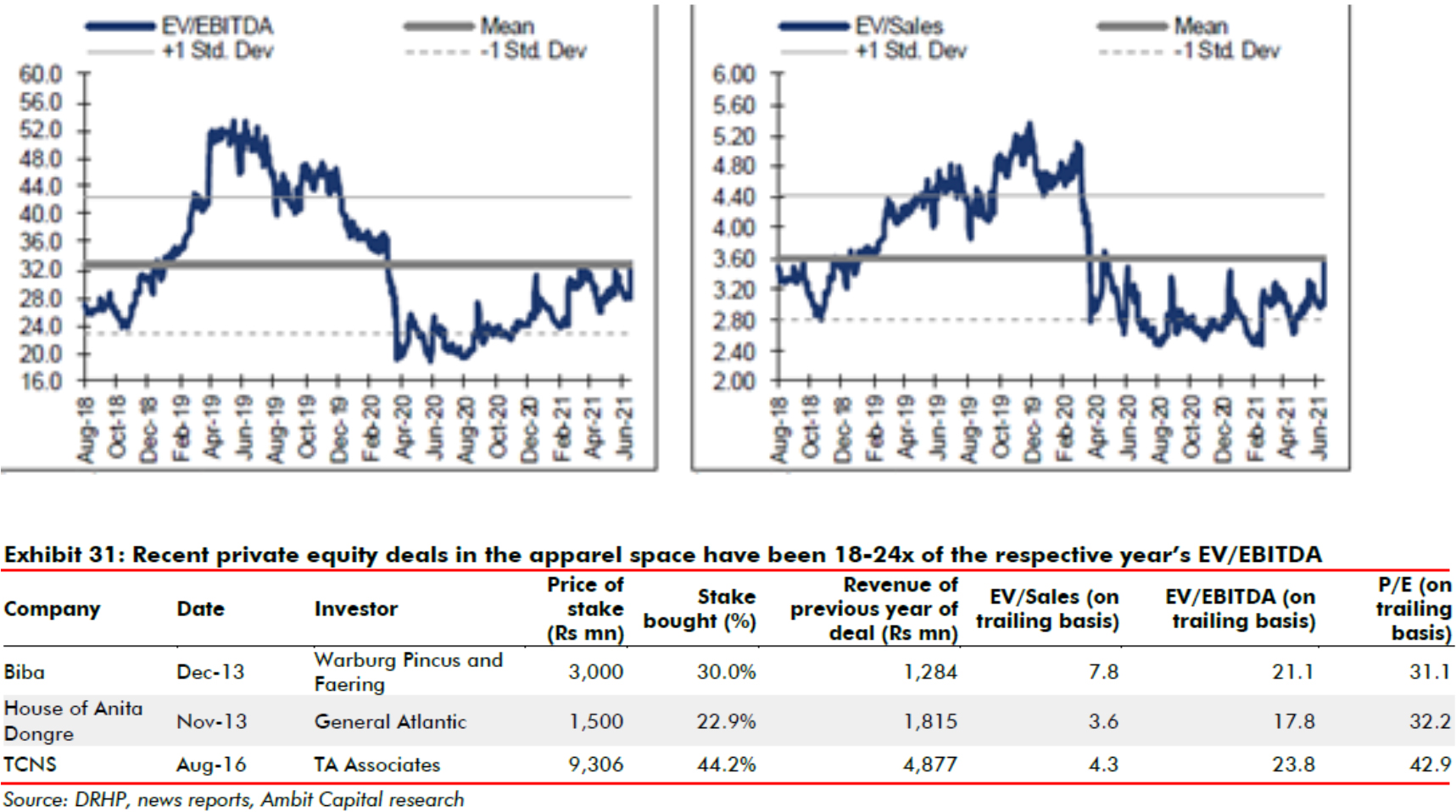
Prevailing valuations provide comfort. Retail is an extremely tough business, and we certainly don’t want to fool ourselves on the historical unit economics of this industry, sustainability of franchises, constant evolving trends, fading away of very good cos & managements. It’s tough!
Interestingly, Branded apparel retail was a space which enjoyed premium multiples in 2016-2018. On a forward basis, cos traded at 4-5x EV/Sales & 18-20x EV/Ebitda. Today, Tcns trades at ~2.5x EV/Sales & ~14x EV/Ebitda FY23. While we are cognizant of the risks prevailing in this industry, we do feel the risk-reward is in our favour.
- Stable, incentivized & professional management team: The promoters have taken a backseat. Bulk of the executive team has been with the company for over eight years, carry esops. The MD has been with the company since 2011 & owns ~6%.
- Proactive focused approach towards online: Has not been caught off-guard post covid, unlike other retailers who were not focused towards the digital channel.
Online share to mix: FY16 7%, FY19 12%, FY20 10%, FY21 27%. Is growing its share of online sales from own websites vs. primarily 3rd party earlier.
“Now, if you look at this channel right now, it’s contributing to about 23%, in midterm, about three years’ time, it should anywhere between at least 1/4 to 1/3 of the total sales. And we ourselves, as a company, are trying to push this”
- Inorganic potential: Tcns has primarily 3 brands W(introduced in 2002), Aurelia(introduced in 2009), Wishful(introduced in 2006). Now trying to grow Elleven (coordinates foray), raise share of footwear & accessories. Healthy cash on the BS.
“one of the stated objectives for us has been inorganic growth; we see many small brands with tremendous potential which due to reasons of managerial bandwidth or probably risk appetite or financial constraints could not scale up. While we have seen multiple attractive assets in the past, we could not align on the right pricing. We see possibility of such assets coming at the right price now. Our industry is extremely fragmented with multiple small players with limited financial resources.”
- Shift towards casual/light wear(WFM) vs heavy ethnic risk: Product offerings of W (Key revenue contributor ~55-60%) are inclined toward Indo-western fusion vs contemporary ethnic. Biba for example has a higher share of contemporary ethnic.
Regards,
Sirius Advisors
Click here to download PDF
Disclaimer:
Sirius Advisors is regulated by the Securities and Exchange Board of India as a provider of Portfolio Management Services.
The information provided on this website does not, and is not intended to, constitute investment advice; instead, all information, content, and materials available on this site are for general informational purposes only. Information on this website may not constitute the most up-to-date information. The enclosed material is neither investment research, nor investment advice. Sirius Advisors does not seek payment for or business from this email in any shape or form. The contents and information in this document may include inaccuracies or typographical errors and all liability with respect to actions taken or not taken based on the contents of this site are hereby expressly disclaimed. The content on this website is provided “as is;” no representations are made that the content is error-free.
No reader, user, or browser of this site should act or refrain from acting on the basis of information on this [site/newsletter] without first seeking independent advice in that regard. Use of, and access to, this website or any of the links or resources contained within the site do not create an portfolio manager -client relationship between the reader, user, or browser and website authors, contributors and their respective employers. The views expressed at, or through, this site are those of the individual authors writing in their individual capacities only.